
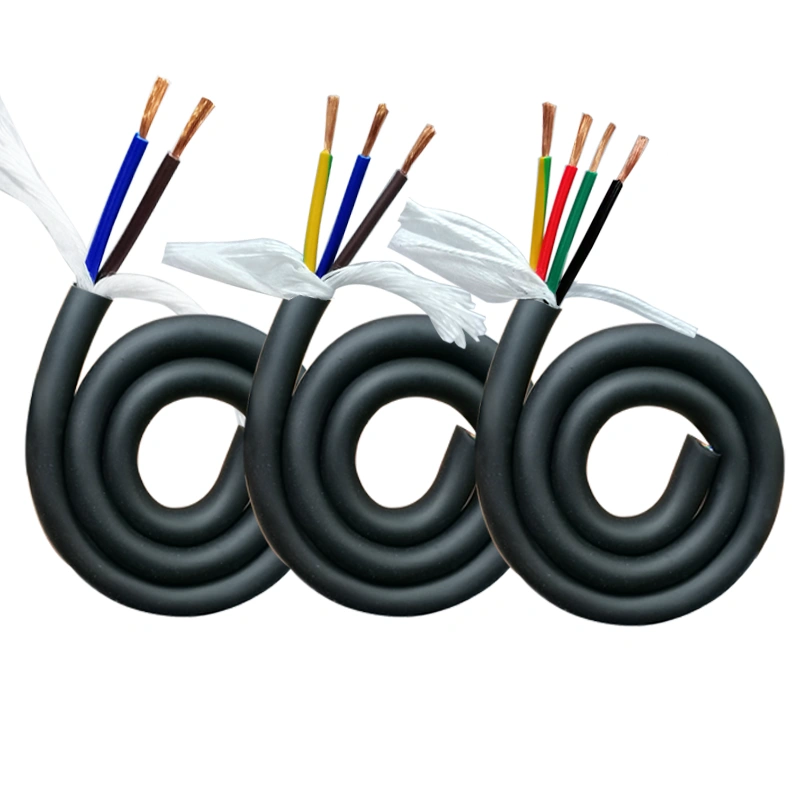
High Flexible Drag Chain Cable TRVV for CNC & Industrial Automation (6 Million Cycles)
TRVV high flexible drag chain cable with 6 million cycles bending life, designed for CNC machines, robots and industrial automation equipment.
View productChoosing a servo motor cable starts with how the axis moves, not with the catalogue. Work through duty, shield, voltage and jacket in that order and the part number usually falls out on its own; this page walks the construction of a dual-layer shielded servo power cable, the four decisions that fix a specification, and the drag-chain families that follow from those answers.

Construction
The TSFDJ-P construction is listed layer by layer on the product page. Read from the conductor outward, every layer exists to answer one of the four selection questions — how it flexes, how it handles interference, how it holds voltage and how it survives the chain.

TSFDJ-P Servo Motor Drag Chain Cable, orange special PVC compound sheath.
The current-carrying layer. In a chain-mounted cable the conductor is the part that rolls and straightens on every cycle, so the material and strand build decide how stable the run stays over a working life.
Packs the gaps between cores so the bundle keeps a round profile as the chain bends, holding the cores in position instead of letting them shift and rub against each other.
Binds the core assembly and separates the insulation from the shield, so the metal braid does not chafe through insulation during repeated travel.
Two shield layers on one cable. The braid gives a durable, flexible path for interference and adds mechanical protection; the foil closes the gaps the braid leaves open. Together they form the dual-layer shielding that makes this a shielded servo power cable rather than a plain power lead.
The outer barrier. It takes the sliding contact and abrasion inside the chain and is the layer the fourth selection question is really about — jacket material against the environment the cable runs in.
The full construction is rated 600/1000V and built for dynamic drag chain duty. See the complete TSFDJ-P specification page.
Selection logic
Answer these four questions in order. Each one removes options and points to a page where the remaining candidates are listed with their own construction details.
Ask Does the axis move continuously, and roughly how many cycles will the cable see in its service life?
Decide Continuous flexing rules out a static power lead and pushes you into a drag-chain family with a published flex rating. This is the decision that eliminates the most options.
Start with the TRVV drag chain familyAsk Does the drive cable share a chain, duct or cabinet route with encoder, signal or control wiring?
Decide Shared routing calls for dual-layer shielding — tinned copper braid plus aluminum foil. On a clean route with interference handled elsewhere, an unshielded drag chain power cable can be the simpler answer.
Compare unshielded and dual-layer shieldedAsk What drive output and system voltage will the cable sit on?
Decide The TSFDJ-P construction is listed at 600/1000V. Match the rating to your machine's voltage class and confirm the final figure against the drive manual before the drawing is released.
Check the 600/1000V rating on the product pageAsk What touches the cable — sliding chain contacts, chips, coolant, oils, outdoor light?
Decide The outer sheath on this cable is a special PVC compound. If your environment goes beyond ordinary machine-shop exposure, put the chemical list in front of our engineers before you commit to a jacket.
Send your environment details to our engineersScenarios
Most specification requests arrive as a machine description rather than a part number. These four setups show which product fact each one turns on, and what to decide next.

Fact in play: the TRVV family page lists CNC and industrial automation use with a six-million-cycle rating.
Decision: start inside the drag chain range rather than a static power lead, then check whether the drive line runs close enough to signal wiring to justify the shielded version.
Fact in play: TSFDJ-P carries a tinned copper braided shield layer plus an aluminum foil shield.
Decision: specify dual-layer shielding and plan the grounding and separation in the panel at the same time — the cable is only half of the noise answer.
Fact in play: the construction uses a cotton rope filler and non-woven tape wrapping to keep the core bundle in position while the chain cycles.
Decision: send travel length and expected cycles to our engineers so the flex rating, not the price list, sets the part number.
Fact in play: the outer sheath is a special PVC compound.
Decision: confirm chemical exposure against that jacket before ordering — if the environment needs a different compound, that conversation belongs before the drawing release.
Shielding
This is where most cost and most rework sit. The answer depends less on the cable than on what else shares the route.
Pick this when power runs on its own route:
Pick this when the chain is crowded:
Specification
Everything the product page publishes about the construction, in one place, so you can drop it into a drawing note or a comparison sheet.
Send travel length, expected cycles, system voltage, shield preference and the environment the cable runs in. Our engineers confirm the construction and come back with a part number.
| Product name | TSFDJ-P Servo Motor Drag Chain Cable |
|---|---|
| Conductor | Oxygen-free pure copper |
| Filler | High-strength cotton rope |
| Wrapping | Non-woven fabric tape |
| Shielding | Tinned copper braided shield layer + aluminum foil shield |
| Rated voltage | 600/1000V |
| Outer sheath | Special PVC compound, orange |
| Duty | Dynamic drag chain applications |
Next step
Duty, shield, voltage and jacket — give us those four and we will confirm the construction that fits. Bulk orders, custom lengths and drawing-specific builds are quoted rather than listed, so the conversation starts with your machine data.
Keep adjacent product options together for a faster catalog comparison.
TRVV high flexible drag chain cable with 6 million cycles bending life, designed for CNC machines, robots and industrial automation equipment.
View product
TRVV High Flexible Drag Chain Cable with 10 Million Cycles life for CNC, robots and automation equipment. Durable sheath and excellent bending performance.
View product
TRVV high-flex drag chain cable engineered for up to 15 million bending cycles. Ideal for robots, CNC machines, packaging equipment and automated production lines. Custom sizes available.
View productReview the product details, images, and specifications presented on the official product page.
Use the application and use-case information published on the official product page.
Confirm the specifications and options listed for the exact product variant before placing an order.
Check the official product page or ask the supplier about options shown for the selected product.
Use the official contact or inquiry path provided on the site.
Include the product page, intended use, required quantity, and any specifications you need the supplier to review.
