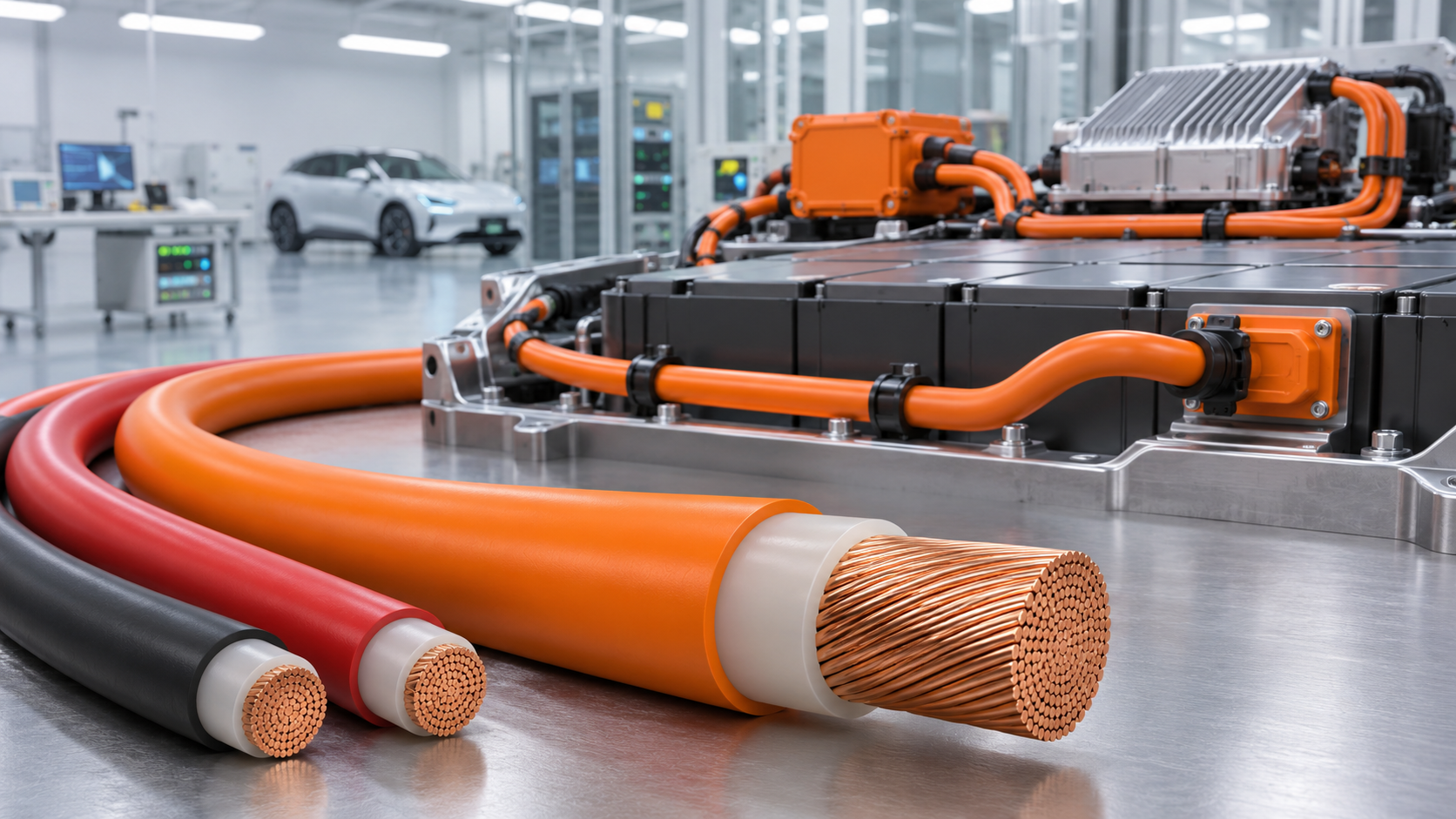
EVR is a flexible, unshielded single-core cable for high-voltage power connections in electric vehicles and new-energy equipment.
Electric vehicles, charging equipment and battery systems need cables that can carry substantial current while fitting into increasingly compact electrical layouts. The cable must provide dependable insulation, tolerate heat and industrial fluids, and connect cleanly to terminals, junction boxes and battery modules.
EVR 1500V high-voltage cable is designed for this kind of protected power wiring. It combines a fine-stranded oxygen-free copper conductor with cross-linked XLPE insulation in a flexible single-core construction. Rolan Cable currently offers sizes from 0.5 mm² to 240 mm², covering small equipment circuits through large high-current connections.
This guide explains the EVR construction, typical applications, conductor sizing, routing considerations and the information buyers should provide before requesting a quotation.
EVR is a 1500V-rated flexible single-core cable developed for new-energy vehicles and electrical equipment. An EVR high-voltage cable is commonly considered for battery, charging, power-distribution and industrial high-voltage connections where a compact unshielded cable is appropriate.
The basic construction is deliberately simple:
There is no aluminum foil, metal braid or separate overall shield in the standard EVR construction. This keeps the cable compact and avoids paying for shielding where the system design does not require it.
| Parameter | Published EVR information |
|---|---|
| Cable type | Flexible single-core high-voltage cable |
| Rated voltage | 1500V |
| Conductor | Fine-stranded oxygen-free copper |
| Insulation | Cross-linked XLPE |
| Standard conductor range | 0.5 mm² to 240 mm² |
| Operating temperature | Approximately -40°C to +125°C |
| Short-term temperature | Up to approximately +150°C |
| Standard colors | Orange, red and black |
| Shielding | None |
| Main properties | Heat, flame, oil and corrosion resistance |
These values are useful for initial selection. The final drawing, conductor structure, outside diameter and test requirements should be confirmed for the exact size ordered.
Large solid conductors are difficult to route inside vehicles and equipment. EVR divides the conductor cross-section into many fine copper strands, allowing the cable to bend more easily during installation while maintaining the required copper area.
Fine stranding provides several practical benefits:
Flexibility during installation should not be confused with continuous-flex performance. EVR is not automatically a drag-chain or robotic cable. If the cable will bend repeatedly during machine operation, a dedicated dynamic cable construction and motion review are required.
XLPE is polyethylene whose molecular structure has been cross-linked. Cross-linking improves heat resistance and dimensional stability compared with ordinary polyethylene, making the material suitable for compact high-voltage insulation systems.
In EVR cable, XLPE provides:
The insulation material is only one part of system safety. Terminals, connectors, seals, enclosures and installation clearances must all be suitable for the same voltage and temperature conditions.
EVR can connect battery modules, distribution units and other protected power components where an unshielded 1500V single-core cable is specified. Orange is commonly used to make high-voltage circuits visible, although final color coding follows the vehicle or equipment design.
Inside charging stations and power cabinets, EVR may be used for protected DC power connections. It should not be confused with the complete flexible charging cable handled by the vehicle user, which normally requires a multi-core construction and different mechanical requirements.
The broad conductor range makes EVR useful for compatible battery racks, DC distribution and equipment-level connections. Energy-storage projects may have their own flame, low-smoke, routing and certification requirements, so the project specification must be reviewed before substitution.
EVR can also serve high-voltage power and equipment-control connections in protected industrial machinery, test equipment and power-conversion systems.
Conductor size is not selected from system voltage alone. A 1500V rating describes insulation capability; it does not tell you how much current the cable can carry.
Sizing should consider:
A longer cable produces more voltage drop and heat for the same conductor size. Bundled cables also dissipate heat less effectively than a single cable in open air. Use the approved electrical design and applicable standard rather than a generic current table copied from another installation.
EVR is available across an unusually broad size range. Small cross-sections can support control or auxiliary circuits covered by the approved design, while large cross-sections serve high-current battery and power-distribution connections.
The same model name does not mean every size behaves identically. As conductor size increases:
Always request the outside diameter and conductor construction for the exact cross-section. These values determine whether the cable fits the intended connector, conduit and routing space.
EVR is an unshielded cable. That is appropriate only when the electrical system and EMC design permit an unshielded power connection.
A shielded cable may be required when:
Shielding adds diameter, weight, material and termination requirements. It should not be added or removed casually. Follow the equipment manufacturer's approved design and grounding method.
Both XLPE and silicone high-voltage cables can be rated for 1500V, but they are chosen for different priorities.
EVR's XLPE construction is attractive for compact protected wiring, broad conductor availability and temperatures within its published range. Silicone cable is often considered when exceptional softness or more extreme hot and cold performance is required.
The decision should include:
Do not substitute one insulation material for another without confirming the complete cable and system requirements.
The EVR product information specifies approximately -40°C to +125°C operation and up to +150°C short-term exposure. These figures should be interpreted together with conductor heating and installation conditions.
Cable temperature is influenced by:
Short-term temperature does not mean continuous operation is permitted at that value. Connectors and terminals may also have lower limits than the cable insulation.
EVR has a flexible conductor, but the installation must still protect the insulation from damage. Good routing practice includes:
For large conductor sizes, cable support and terminal alignment deserve special attention. A heavy cable forced into position can transfer mechanical load into the connector or busbar.
The correct conductor size is useful only if it can be terminated properly. Before ordering EVR cable, verify:
Fine-stranded conductors require terminals and crimp processes intended for that strand construction. Do not cut away strands to make an oversized cable fit a smaller terminal.
Rolan Cable offers EVR in orange, red and black. Orange is widely associated with high-voltage vehicle circuits, while red and black may be used for polarity or equipment identification where the project standard permits.
Color alone does not prove voltage rating. Cable markings, drawings and installation documentation should provide positive identification. Confirm any project-specific printing, meter marking or branding before production.
EVR should not be selected only because it is flexible and rated 1500V. It is not automatically a substitute for:
Each of these applications introduces structural, environmental or certification requirements beyond the basic EVR construction.
Provide the following information to receive an accurate recommendation and price:
For customized production, provide a drawing or complete existing cable specification. A photograph of an orange cable does not confirm conductor size, voltage rating or insulation material.
Voltage determines insulation requirements. Current, length, temperature and installation conditions determine conductor sizing.
EVR is easy to route because of its fine-stranded conductor. That does not make it a cable for millions of bending cycles.
Standard EVR has no foil or braid. Confirm the EMC requirement before using it near power electronics or sensitive circuits.
Large cross-sections can exceed the seal or gland range of a selected connector. Confirm finished outside diameter early.
The short-term value is not the normal operating limit. Review the complete thermal profile and component ratings.
EVR identifies a flexible single-core high-voltage cable for new-energy vehicle and equipment applications. The Rolan EVR construction uses fine-stranded oxygen-free copper with XLPE insulation.
The current Rolan EVR product is rated at 1500V.
No. Standard EVR is an unshielded single-core cable. Use a suitable shielded high-voltage model when the system EMC design requires shielding.
The published range is 0.5 mm² to 240 mm². Final diameter and conductor construction depend on the selected size.
Not automatically. A flexible installation wire is different from a continuous-flex drag-chain cable. Repeated-motion applications require separate technical confirmation.
Yes. Size, color, surface printing and packaging can be customized after the electrical, environmental and order requirements are confirmed.
EVR offers a straightforward combination: fine-stranded copper, 1500V XLPE insulation, flexible routing and sizes from 0.5 mm² to 240 mm². It is a practical choice for protected unshielded connections when the conductor size, temperature, routing and terminal system are correctly specified.
View the EVR 1500V high-voltage cable product page, explore Rolan Cable's EV high-voltage cable range, or contact our cable team with your current, size, length, temperature and application details for a quotation.


