

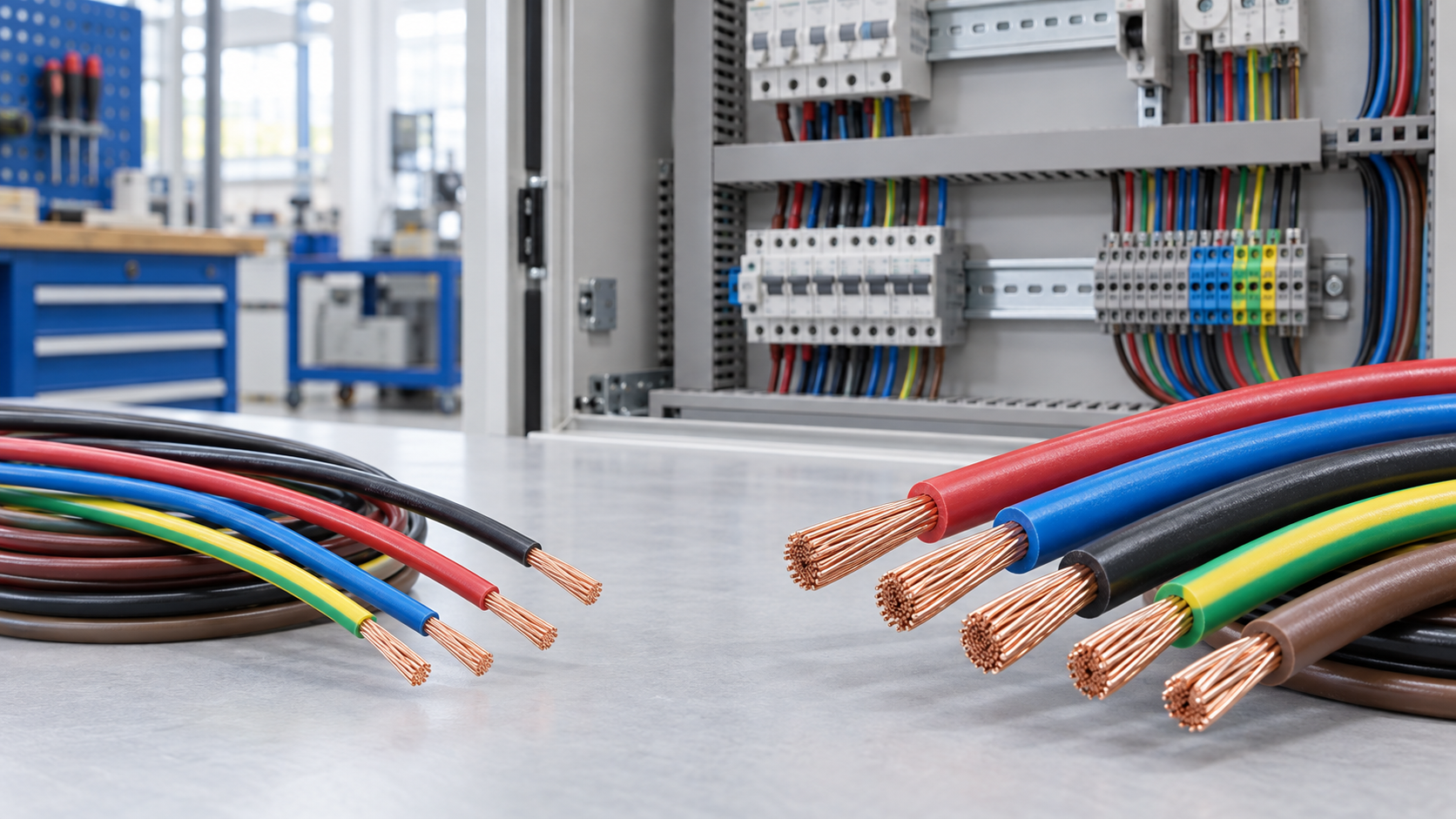
H05V-K and H07V-K look similar, but their voltage ratings and typical applications are not the same.
H05V-K and H07V-K are flexible single-core PVC-insulated wires commonly used inside electrical equipment, control cabinets, switchgear and appliances. Both use fine-stranded copper conductors, both are available in multiple identification colors, and both are intended for protected installation. That similarity can make them easy to confuse.
The most visible difference is the rated voltage: H05V-K is typically 300/500V, while H07V-K is typically 450/750V. The correct choice, however, is not made from voltage alone. Conductor size, current, installation method, ambient temperature, terminal type and the applicable equipment standard must all be reviewed.
This guide explains what the model names mean, where each wire is normally used and what information to include when buying European-standard single-core wire.
Understanding the H05V-K and H07V-K Designations
The letters and numbers provide a compact description of the wire family. In general:
- H identifies a harmonized-type cable designation
- 05 corresponds to the 300/500V voltage class
- 07 corresponds to the 450/750V voltage class
- V identifies PVC insulation
- K identifies a flexible fine-stranded conductor intended for fixed protected wiring
The designation describes important construction features, but it is not a complete specification. A purchase order should also state conductor size, color, required standard or approval, packaging and any project-specific tests.
The Main Difference: Voltage Rating
| Feature | H05V-K | H07V-K |
|---|---|---|
| Typical rated voltage | 300/500V | 450/750V |
| Conductor | Fine-stranded copper | Fine-stranded copper |
| Insulation | PVC | PVC |
| Cable form | Flexible single-core insulated wire | Flexible single-core insulated wire |
| Typical location | Protected appliance, instrument and equipment wiring | Control cabinets, switchgear and industrial equipment |
| Outer sheath | None | None |
| Shielding | None | None |
The higher H07V-K voltage class does not automatically make it the correct replacement for every H05V-K circuit. The equipment design, terminal range, wiring space and certification documents may specify one particular model.
Where H05V-K Is Commonly Used
H05V-K is generally selected for protected internal wiring in equipment operating within the 300/500V class. Typical uses include:
- Household and commercial appliances
- Instruments and measurement equipment
- Lighting and electronic assemblies
- Small control boxes
- Internal wiring protected by an enclosure or wiring duct
Its fine-stranded conductor makes it easier to route around corners and terminate in compact devices than a solid conductor of the same cross-section.
H05V-K is not an all-purpose installation cable. Without an outer sheath, it normally requires mechanical protection and should not be exposed to weather, direct abrasion or unsupported outdoor installation unless the approved specification explicitly permits it.
Where H07V-K Is Commonly Used
H07V-K is widely used for protected wiring in industrial control panels and electrical distribution equipment where the 450/750V class is required. Common applications include:
- Industrial control cabinets
- Switchboards and switchgear
- Machine electrical enclosures
- Panel wiring ducts
- Motor-control equipment
- Power distribution inside protected assemblies
The wire's flexibility helps panel builders create neat routes through ducts and make reliable terminal connections. Larger conductor sizes are also easier to handle when the copper is finely stranded.
Flexible Does Not Mean Continuous Flexing
The “K” conductor is flexible for installation and termination, but H05V-K and H07V-K are not automatically drag-chain or robotic cables. Once installed inside a panel or protected enclosure, the wire is normally expected to remain stationary or experience only limited service movement.
Applications involving millions of bending cycles, continuous torsion, reeling or repeated machine travel require a cable specifically designed for that motion. Using H07V-K inside a moving drag chain simply because it bends easily by hand can lead to conductor fatigue or insulation damage.
For moving-machine wiring, specify travel, speed, acceleration, bend radius and cycle requirement so the manufacturer can recommend a suitable high-flex cable family.
Choosing the Correct Conductor Size
Voltage class and conductor size answer different questions. The model determines the insulation system and voltage rating; the cross-section helps determine current-carrying capability and voltage drop.
Wire sizing should consider:
- Continuous and peak current
- Ambient temperature inside the enclosure
- Number of loaded conductors grouped in the same duct
- Ventilation and heat from nearby components
- Circuit length and acceptable voltage drop
- Protective device rating
- Terminal and ferrule capacity
- Applicable electrical code or equipment standard
Do not select the cross-section from current alone without applying the required installation and temperature factors.
Why Fine-Stranded Copper Helps Panel Wiring
A fine-stranded conductor distributes the copper across many small strands. This makes the wire easier to bend and route through narrow wiring channels. It also reduces the force placed on small terminals compared with a stiff conductor.
The strands must be contained correctly at the terminal. Loose strands can reduce contact area or create a short circuit. In many panel-building practices, a correctly sized ferrule is crimped onto the stripped end before insertion into a screw or spring terminal. Follow the terminal manufacturer's instructions rather than assuming one termination method suits every device.
Insulation Color and Circuit Identification
H05V-K and H07V-K are supplied in several PVC insulation colors to support circuit identification. Color selection should follow the applicable national standard, customer drawing and equipment rules.
Green-yellow is normally reserved for protective conductors and should not be used as a general live-circuit color. Other colors may identify neutral, control voltage, AC phases or DC polarity depending on the project standard.
When ordering customized colors, confirm that they will remain consistent across production batches and that printed markings, if required, remain legible.
Installation Inside Wiring Ducts
Good panel wiring is not only about appearance. Crowded ducts trap heat, make maintenance difficult and can place pressure on insulation. Leave sufficient fill space and keep power, control and sensitive signal circuits separated where required by the design.
Avoid pulling wire over sharp metal edges. Use suitable bushings where conductors pass through panels, and maintain bend radii that do not stress the insulation or terminal. Secure the wire without overtightening ties.
Because these wires have no overall sheath, the enclosure, duct and routing system provide much of their mechanical protection.
H05V-K or H07V-K for a Control Cabinet?
H07V-K is commonly associated with industrial control-cabinet wiring because of its 450/750V rating. However, not every circuit in a cabinet necessarily has the same requirement. Low-voltage auxiliary circuits may be designed around a different approved wire.
Use the electrical drawing, bill of materials and equipment standard as the starting point. Substituting H07V-K for H05V-K may appear conservative, but changes in outside diameter, terminal fit, documentation or approvals still need review. Substituting H05V-K into a circuit specified for H07V-K is not acceptable merely because the operating voltage appears low.
H05V-K/H07V-K vs. Multi-Core Cable
Single-core panel wire is ideal when individual conductors are routed inside a protected enclosure. A multi-core cable is usually more practical when several conductors must travel together between enclosures or through an external route.
Choose a multi-core cable when the installation needs:
- A common protective outer sheath
- Easier routing between machines or cabinets
- Resistance to external abrasion or contaminants
- Overall shielding for electromagnetic compatibility
- A defined flexible or continuous-motion construction
Do not bundle individual H07V-K wires together and treat the result as equivalent to a tested multi-core cable.
Buying Checklist
Include the following information in an enquiry or purchase order:
- Model: H05V-K or H07V-K
- Conductor cross-section
- Insulation color and quantity by color
- Required voltage class
- Applicable standard, certification or customer specification
- Conductor material and stranding requirement
- Operating temperature and installation environment
- Packaging length and spool or coil requirement
- Printed marking requirements
- Required test reports or compliance documents
Rolan's H05V-K/H07V-K flexible single-core PVC wire uses fine-stranded high-purity copper and flame-retardant PVC insulation. Final sizes, colors, documentation and approvals should be confirmed before production.
Common Mistakes to Avoid
Selecting by color only
Insulation color identifies a circuit; it does not confirm voltage rating, conductor size or compliance.
Assuming all flexible wire is moving cable
H05V-K and H07V-K are flexible for installation. They are not substitutes for dedicated drag-chain, torsion or reeling cable.
Ignoring terminal compatibility
The conductor cross-section, stripped length and ferrule must fit the terminal. A poor termination can overheat even when the wire itself is correctly sized.
Using unprotected single-core wire outdoors
These wires have insulation but no outer cable sheath. Exposure to UV, water and mechanical damage requires an appropriate cable or protective wiring system.
Ordering without specifying a standard
Similar-looking wire may be produced to different requirements. State the required standard and documentation rather than relying on the model name alone.
Frequently Asked Questions
Can H07V-K replace H05V-K?
Only after the equipment designer confirms voltage, dimensions, terminal fit, documentation and compliance. A higher voltage rating alone does not authorize a substitution.
Can H05V-K be used in a control panel?
It may be suitable for protected circuits designed for its voltage class, but the equipment specification and applicable standard must be followed.
Are H05V-K and H07V-K shielded?
No. They are single-core PVC-insulated wires without foil, braid or an outer sheath.
Are they suitable for cable trays?
Installation permissions depend on the wiring system and applicable code. They are generally intended for protected installation in equipment, conduits or ducts rather than exposed use.
What does “K” mean?
It identifies a flexible fine-stranded conductor in the harmonized designation system. It does not mean the wire is suitable for continuous machine movement.
Start With the Drawing, Not the Color
H05V-K and H07V-K are simple, dependable choices for organized equipment wiring when they are used in the correct voltage class and protected installation. H05V-K is typically associated with 300/500V appliance and equipment circuits, while H07V-K is commonly used for 450/750V cabinet and industrial wiring.
Browse Rolan Cable's European-standard single-core wire, or contact our team with your model, conductor size, colors, quantity and compliance requirements for a quotation.

